Positioned for What's Coming: How a Rural Lane Address Doubles as a Climate Resilience Strategy
For most of American real estate history, the appeal of a lane address was framed in romantic terms — the quiet morning, the tree-lined approach, the sense of arrival that comes with distance from the main road. Those qualities remain as compelling as ever. But a new and more urgent conversation is beginning to reshape how buyers think about properties like those found along Hicks Lane. Climate risk, once treated as a peripheral concern in real estate decisions, has moved to the center of the table.
Insurance actuaries, municipal planners, and a growing number of residential buyers are now asking a question that would have seemed unusual a decade ago: Is this address structurally positioned to endure what the next thirty years of weather will bring?
For lane properties across the United States, the answer is increasingly favorable — and the reasons are grounded in geography, engineering, and ecological function rather than sentiment.
The Drainage Difference
Flood damage remains the single most costly category of weather-related residential loss in the United States, according to data from the Federal Emergency Management Agency. Much of that damage is not caused by proximity to rivers or coastlines alone. A significant portion results from impervious surface runoff — the phenomenon in which rainwater, unable to penetrate concrete and asphalt, accumulates rapidly and overwhelms drainage infrastructure in densely developed neighborhoods.
Lane properties operate under fundamentally different hydrological conditions. Larger lot sizes, natural ground cover, and the relative scarcity of impervious surfaces mean that rainfall is more likely to be absorbed gradually by the surrounding landscape. Gravel or unpaved lane surfaces, native vegetation buffers, and natural topographic variation all contribute to what engineers call infiltration capacity — the land's ability to absorb and slow precipitation before it becomes a structural threat.
Buyers evaluating a lane property should engage a licensed civil engineer or environmental consultant to assess site-specific drainage patterns, particularly in areas with heavy seasonal rainfall. That due diligence, while modest in cost, can confirm whether a given parcel functions as a natural sponge or as an unrecognized flood risk.
Wind Exposure and the Geometry of Shelter
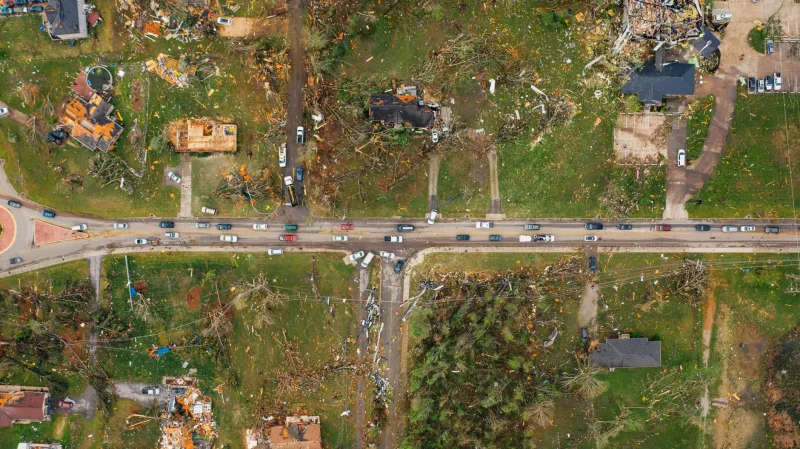
The relationship between property layout and wind vulnerability is less frequently discussed than flooding, but no less significant. Suburban homes situated in open, uniform grids offer little in the way of natural windbreak. A sustained storm system moves through those neighborhoods with relatively unimpeded force.
Lane properties, by contrast, are often set within a more complex landscape — one that includes mature tree stands, elevation changes, and structural setbacks from primary roadways. These features collectively reduce wind load on residential structures in ways that no engineering retrofit can fully replicate after the fact.
This is not a casual observation. The Insurance Institute for Business and Home Safety has published research indicating that natural vegetation buffers can meaningfully reduce wind-driven debris impact, one of the primary mechanisms through which residential structures sustain damage during severe storm events. A home surrounded by established hardwoods is not immune to storm damage, but it is operating within a different risk profile than an identically constructed home on an exposed suburban cul-de-sac.
Fire-Safe Setbacks and Defensible Space
Wildfire risk has expanded well beyond the western states that once defined the conversation. Across the Southeast, the mid-Atlantic, and parts of the Midwest, seasonal fire conditions have intensified as drought cycles lengthen and fuel loads accumulate in previously managed rural landscapes.
The concept of defensible space — a buffer zone of modified vegetation and cleared area surrounding a residential structure — has become a standard element of fire resilience planning. Lane properties, owing to their larger footprints and lower structural density, are inherently better positioned to accommodate that buffer without requiring the demolition of neighboring structures or the cooperation of adjacent property owners.
Firefighters and fire safety professionals consistently note that access is among the most critical factors in determining whether a structure can be defended during a wildfire event. A lane address that provides clear, unobstructed vehicle access from multiple directions offers a meaningful operational advantage over a home embedded within a dense subdivision where evacuation routes may become congested or compromised.
Buyers in fire-adjacent regions should consult state forestry resources and local fire district assessments when evaluating lane properties. Many states now publish parcel-level fire hazard severity zone maps that can inform both purchase decisions and insurance negotiations.
The Insurance Premium Calculus
The financial consequences of climate risk are now being priced in real time. Major insurers have withdrawn from or significantly restricted coverage in several states over the past three years, citing unsustainable loss ratios driven by extreme weather events. In Florida, California, and Louisiana, the retreat of private carriers has left homeowners dependent on state-administered last-resort programs that carry higher premiums and reduced coverage terms.
This trend is not confined to those states. Insurers are repricing risk nationally, and the methodology increasingly incorporates granular, parcel-level climate data rather than broad regional averages. A property's elevation, proximity to flood-prone areas, vegetation type, and structural density all factor into emerging actuarial models.
Lane properties with favorable drainage characteristics, mature vegetative buffers, and low structural density may qualify for more competitive premium structures as insurers refine their climate-adjusted underwriting. Buyers should request a detailed insurance consultation prior to closing, specifically asking carriers to explain how the property's physical characteristics influence its risk classification. That conversation, conducted before a purchase is finalized, can reveal both the true cost of coverage and opportunities to negotiate terms based on demonstrable site-specific resilience features.
Address Selection as Adaptation
The framing of real estate decisions as climate adaptation choices represents a meaningful shift in how buyers are approaching the market. Rather than treating a home purchase as a transaction optimized for square footage, school district proximity, or commute time alone, a growing segment of buyers is incorporating long-horizon risk analysis into the selection process.
A lane address in a well-positioned rural or semi-rural setting does not eliminate climate risk. No address can. But it offers a set of physical characteristics — drainage capacity, wind shelter, defensible space, and lower structural density — that collectively reduce exposure to the categories of loss that are becoming more frequent and more financially significant across the United States.
At 18 Hicks Lane, the appeal of a quiet, considered address has always been rooted in something more durable than trend. The lane itself — its setbacks, its natural surroundings, its measured distance from the pressures of dense development — represents exactly the kind of physical positioning that climate-aware buyers are now seeking with deliberate intention.
The question worth asking is not simply where you want to live. It is where your home will be best positioned to endure the decades ahead.