Beyond the Floor Plan: The Property Attributes That Quietly Determine Long-Term Value
Open any real estate listing and the numbers appear immediately: square footage, bedroom count, bathroom tally, lot size in acres. These figures have long served as the primary vocabulary of residential valuation — a shared language between buyers, sellers, and the appraisers who bridge them.
But something is shifting. Particularly in the rural and lane-front property segment that defines communities like those surrounding 18 Hicks Lane, buyers are increasingly evaluating homes through a richer, more nuanced framework. The result is a market where the most consequential value drivers are often the ones that never appear in a standard MLS data field.
The Evolving Buyer Profile
To understand why intangible attributes now carry greater weight, one must first understand who is purchasing rural and lane-front properties today. The demographic has broadened considerably. Remote-work flexibility has untethered a significant portion of the American workforce from geographic proximity to employment centers, fundamentally altering the calculus of where one chooses to live.
A 2024 survey conducted by the National Association of Realtors found that among buyers who purchased homes more than 50 miles from a major metropolitan area, "privacy and seclusion" ranked as a top-three purchase motivator for 61 percent of respondents — surpassing school district quality and proximity to shopping for the first time in the survey's history.
This is a buyer who is not simply purchasing square footage. They are purchasing an experience, an environment, and — critically — a long-term investment in a specific quality of life.
Privacy: The Premium That Defies Easy Quantification
Few attributes command more consistent buyer enthusiasm in the rural property segment than genuine privacy — and yet it remains among the most difficult characteristics to assign a precise dollar figure to.
Privacy in this context encompasses multiple dimensions. Visual privacy — the degree to which a property is screened from neighboring structures and public roads — is perhaps the most immediately perceptible. Acoustic privacy, meaning freedom from traffic noise, commercial activity, and dense residential sound, is equally significant but often overlooked until it is absent. And then there is what might be termed psychological privacy: the simple knowledge that one's daily movements are not visible to or impacted by others.
For sellers of lane-front properties, articulating privacy as a concrete feature rather than a vague amenity is essential. Specific descriptors matter: mature tree buffers with estimated canopy spread, distance from the nearest public road, lot configuration that minimizes sightlines to neighboring parcels. These details transform an abstract selling point into a tangible asset.
Research from the Urban Land Institute suggests that verifiable privacy features — documented setbacks, natural screening, and lane-only access — can contribute between 5 and 15 percent in premium pricing relative to otherwise comparable properties without those characteristics. That range is meaningful in any market.
Natural Surroundings: Scenery as a Durable Value Driver
The pastoral view from a kitchen window is not merely aesthetic. It is, increasingly, a financial asset with measurable staying power.
A body of research spanning the last two decades has consistently demonstrated that residential properties with views of natural landscapes — woodlands, open meadows, water features, and mountain vistas — appreciate at rates that outpace comparable properties without such views. A frequently cited study from the American Journal of Agricultural Economics found that wooded lot surroundings contributed an average premium of 10 to 20 percent to rural residential sale prices, with waterfront or water-view properties commanding even greater differentials.
For buyers evaluating rural properties, the quality and permanence of natural surroundings deserve careful scrutiny. Not all scenery is equally durable. Buyers should assess:
- Adjacent land ownership and zoning: A currently undeveloped parcel adjacent to your property that is zoned for commercial or high-density residential use represents a future risk to both view quality and privacy.
- Conservation easements and deed restrictions: Properties in areas with active land conservation programs or permanent easements on neighboring parcels offer significantly more stable long-term environments.
- Seasonal variation: A property that presents beautifully in summer may reveal different characteristics in winter. Visiting across seasons — or requesting documentation of year-round conditions — is prudent.
Property Access: The Lane as an Asset
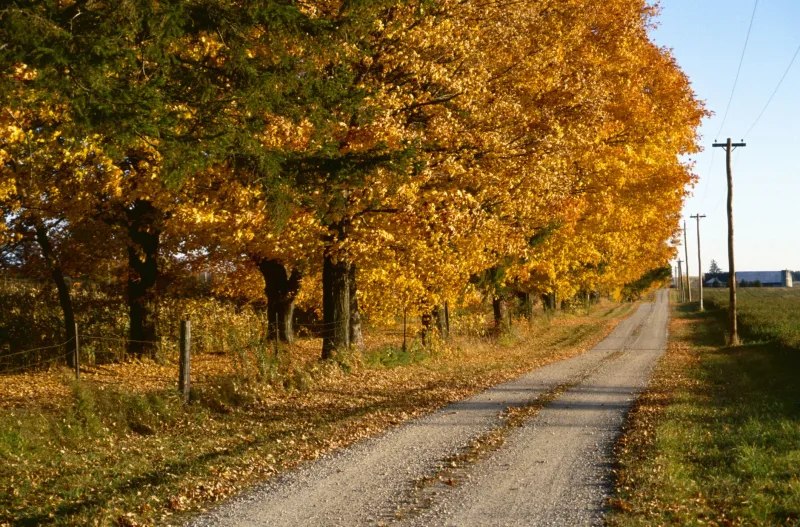
The road — or lane — leading to a property is rarely discussed as a value driver in conventional real estate marketing. It should be.
In the lane-front and rural property context, access characteristics influence daily quality of life, maintenance costs, insurance considerations, and even emergency service logistics. A well-maintained private lane with clear legal access easements and defined maintenance responsibilities is a meaningfully different asset than a poorly documented shared driveway with ambiguous legal standing.
For sellers, proactively assembling documentation related to lane access — including recorded easements, maintenance agreements, road surface specifications, and any homeowners' association or shared-maintenance arrangements — signals professionalism and reduces the friction that can derail transactions during due diligence.
For buyers, the question "who maintains this road and at whose expense?" is not a minor administrative detail. It is a material financial and logistical consideration that deserves a clear, documented answer before closing.
Community Character: The Attribute That Appreciates With Time
Perhaps the most underappreciated value driver in rural and lane-front real estate is the character of the surrounding community — a quality that is genuinely difficult to manufacture and impossible to retrofit once a neighborhood's identity has been established.
Community character encompasses the density and nature of neighboring land uses, the demographic stability of the surrounding area, the presence (or absence) of local institutions such as community organizations, farmers' markets, and volunteer fire departments, and the general ethos of stewardship that residents apply to their properties.
These factors are not merely sociological observations. They have direct financial implications. Properties embedded in stable, engaged rural communities with low turnover and strong land stewardship norms consistently demonstrate more resilient pricing through market cycles than isolated properties in areas with fragmented or transient community fabric.
Actionable Guidance for Sellers
For homeowners preparing to list a rural or lane-front property, the following practices translate intangible assets into compelling, credible marketing narratives:
- Document what cannot be photographed: Commission a professional survey that clearly delineates property boundaries, setbacks, and easements. Provide written descriptions of privacy features, screening vegetation, and acoustic conditions.
- Contextualize the surroundings: Research and disclose adjacent land ownership, zoning designations, and any conservation protections that affect neighboring parcels.
- Quantify access: Provide a clear, written summary of lane maintenance responsibilities, historical maintenance costs, and the legal framework governing access.
- Tell the community story: A brief, factual narrative about the surrounding community — local institutions, land use patterns, neighbor tenure — adds context that photographs alone cannot convey.
Actionable Guidance for Buyers
For those evaluating rural and lane-front properties, the most consequential due diligence often occurs away from the listing sheet:
- Request GIS or county assessor data on adjacent parcels to understand current and permitted land uses.
- Speak directly with neighboring property owners about community norms, road maintenance practices, and any planned development activity in the area.
- Engage a local real estate attorney — not merely a title company — to review easement documentation and access agreements.
- Model long-term carrying costs that include lane maintenance, extended travel distances, and any infrastructure upgrades the property may require.
The floor plan matters. It always will. But in the rural and lane-front property market, the most enduring value is often found in the acres beyond the walls, the lane leading to the door, and the quiet that greets you every morning when you step outside.